


Melting traces 
The mountain hare prefers habitats with long winters and cool summers. Climate change is therefore a major challenge for this species.
The mountain hare is perfectly adapted to life in the mountains: in winter, its fine undercoat and hollow, air-filled guard hairs provide optimal insulation against the cold, while its large, furry paws serve as "snowshoes". It is also a master of camouflage: in autumn, its fur turns white, and in spring brown again – a process triggered by changes in daylight.
But with climate change, snow often arrives too late or melts too early. The mountain hare loses its camouflageand becomes easy prey for eagles, eagle owls, foxes, lynxes, and wolves. It is also sensitive to heat.
This species has sparked our interest. Since 2014, we have been studying its ecology, dispersal patterns, and population dynamics.
Discover surprising insights into this research in the animated video.
From valley floor to mountain peak 
Since 2014, we have been recording the mountain hare population at Munt la Schera in the Swiss National Park.
The study area spans nearly 1,000 meters in elevation, from the river valley to the summit plateau.
It includes a wide variety of habitats such as structurally rich coniferous forests, dwarf mountain pine stands, alpine meadows, pastures and dwarf shrubs, as well as scree slopes and rock fields.

Every winter, we visit the 3.5 km² study area at Munt la Schera. We collect droppings at fixed search points along a regular grid, as well as along fresh hare tracks crossing the grid.
Thanks to genetic fingerprinting, we have been able to describe the spatial and temporal distribution of individuals, changes in population size, and the sex ratio of the population over the years.

Hidden, yet still accessible to study 
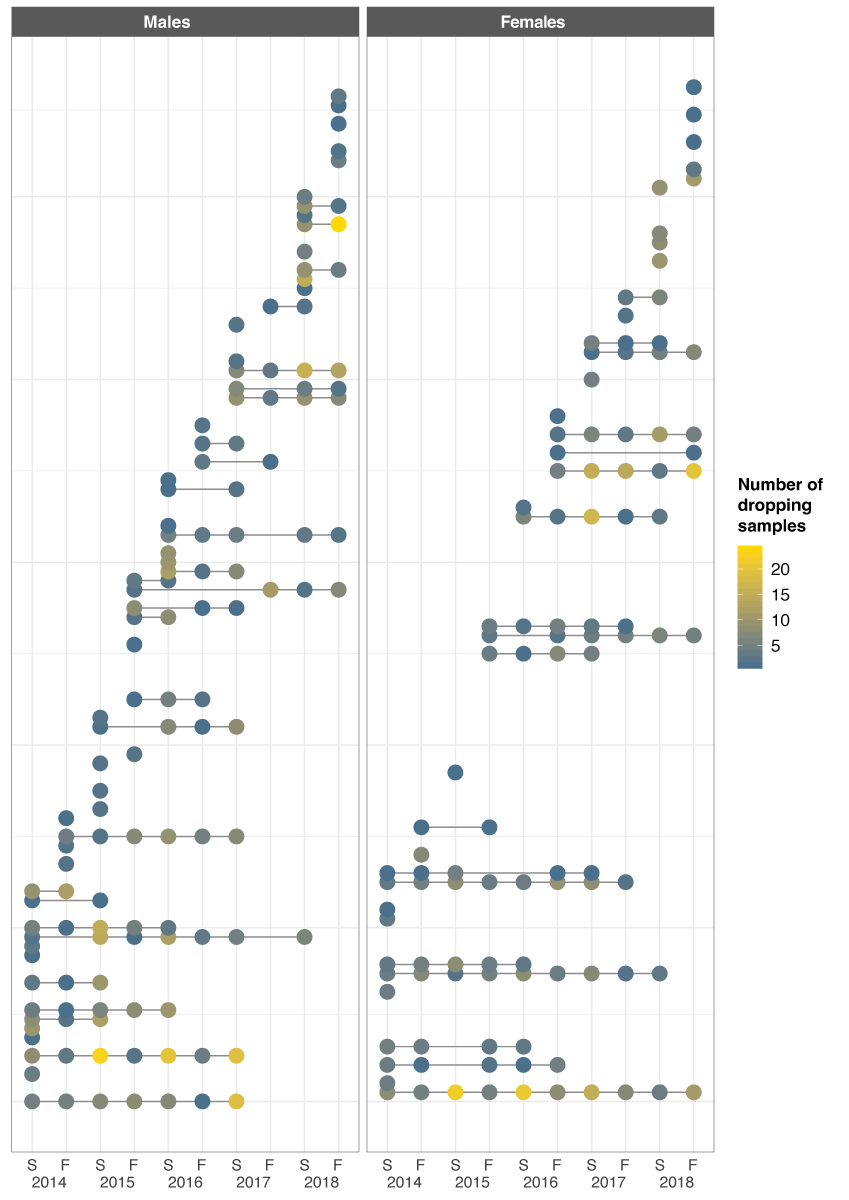
To study the elusive, mostly twilight- and night-active mountain hare, we collected droppings at Munt la Schera over four and a half years. Thanks to the DNA they contain, we were able to clearly distinguish individual animals by their genetic fingerprint.
Overall, we detected females multiple times more often than males. This is illustrated in the graphic as longer lines and more points per individual.
The shorter lines for males have two reasons: on the one hand, in their search for mating partners they cover considerably larger distances, which meant we found their droppings less often. In addition, they are more exposed to predators. Females, on the other hand, usually remain in a smaller area and are therefore easier to track repeatedly.
Where do mountain hares roam? 

Our results so far show:
- Mountain hares are found mainly at the upper tree line and in stands of dwarf mountain pine.
- The size of their population fluctuates by 10 to 50 percent from year to year.
- A broader spatial survey, which included not only the study area in the Swiss National Park (orange area on the map) but also surrounding occurrences, showed that individual animals move back and forth between valleys, using surprisingly large home ranges.
Meet the scientist 

Contact 
Dr. Kurt Bollmann
Head of Research Unit a.i.
Biodiversity and Conservation Biology
kurt.bollmann(at)wsl.ch
+41 44 739 2411
WSL Birmensdorf